

18 May Oxpeckers lifts the veil of secrecy from Botswana’s flagship gas project
After months of tense discussions with authorities, Oxpeckers journalist Sello Motseta finally gets to see the environmental plan for Botala Energy’s coal bed methane project near Serowe
This is how it works: Sello Motseta (left) interviews Botala Energy project manager Moemedi Matsheledi and executive chair Wolf Martinick (right) in Gaborone in February 2026 . Photo: Tshekiso Tebalo / Oxpeckers
After months of protracted negotiations fuelled by media coverage by Oxpeckers, authorities in Botswana finally allowed the publication to view the Environmental Impact Assessment (EIA) report for the country’s flagship gas project.
In March 2026 we investigated the Botala Energy gas exploration project based about 40km outside Serowe, in northern Botswana. Titled “Botswana bets on gas boost for flagging economy”, our article revealed that industry experts and environmental watchdogs were worried about a lack of transparency – and warned that the project may contain risks for the surrounding communities, wildlife and ecosystems.
We reported on the veil of secrecy around the true nature of these risks after the Department of Environmental Protection reneged on an initial commitment to furnish Oxpeckers with a copy of the EIA, which documents multi-step processes used to predict and mitigate the environmental, social and economic consequences of a proposed project before it is approved.
Appeals to Botala Energy Ltd, the Australian mining company that is drilling wells almost 400m deep into coal beds to extract gas, for the opportunity to review the EIA were also unsuccessful.
Our investigation was followed up by several Botswana-based media outlets, including radio stations Gabz-FM and Duma FM.
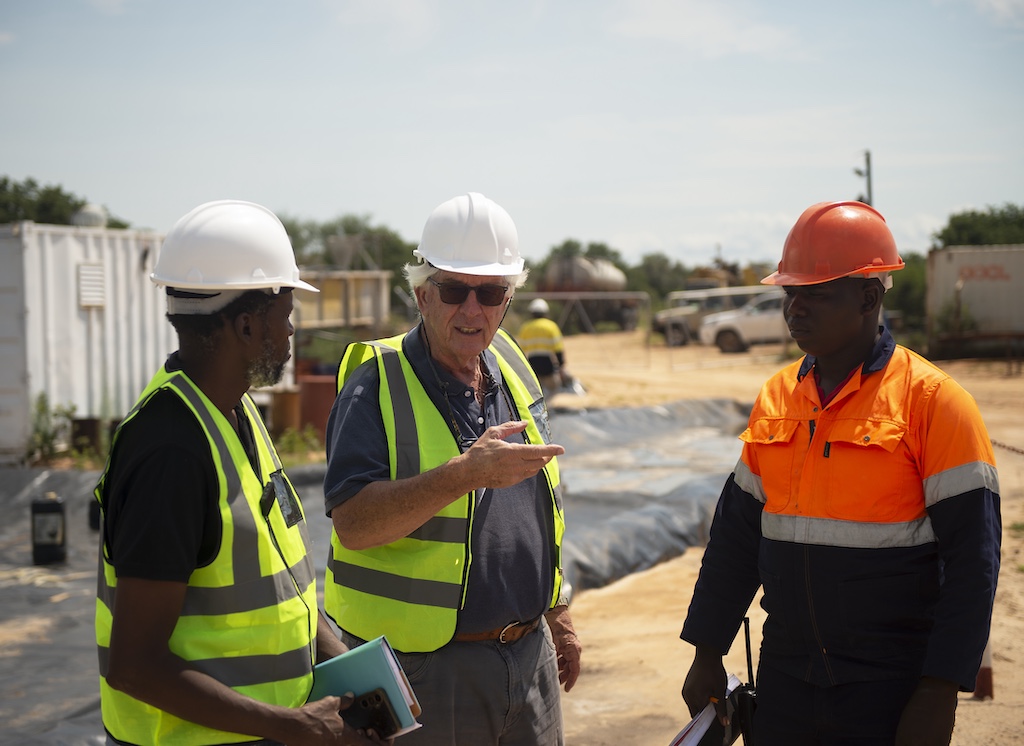
On site: Sello Motseta (left) on a guided tour of the coal bed methane project, about 40km outside Serowe, on February 20 2026. Photo: Tshekiso Tebalo / Oxpeckers
Stringent conditions
In May 2026 Oxpeckers journalist Sello Motseta was finally granted access to view the EIA report at the offices of the Department of Environmental Affairs in Gaborone, subject to stringent conditions – including that he could not have any recording devices, cameras or laptops with him.
“Access to the report shall be limited to on-site review at the Department of Environmental Affairs-South Offices during official working hours,” said a letter shared by state officials, in authorising access after a period of tense discussions with authorities.
The about-turn by the authorities appeared to have been catalysed by a direct personal appeal by the journalist to Wynter Boipuso Mmolotsi, Minister of Environment and Tourism, and a formal complaint laid in April with the Environmental Assessment Practitioners Board, a statutory body mandated to register, regulate and monitor environmental assessment practitioners in Botswana.
The official authorisation letter asserted: “No copying of the report, in whole or in part shall be permitted. This includes but is not limited to photocopying, scanning, photographing or any other form of reproduction.”
It remains unclear why access to the EIA report is restricted and why it is not available for public scrutiny at public institutions such as libraries. Written requests for clarification on this point remain unanswered.
This is despite the government passing the Access to Information Act (Act 16 of 2024) in Parliament in August 2024. It guarantees the public’s right to access information held by state and public authorities without delay and at no cost, barring standard document reproduction fees.
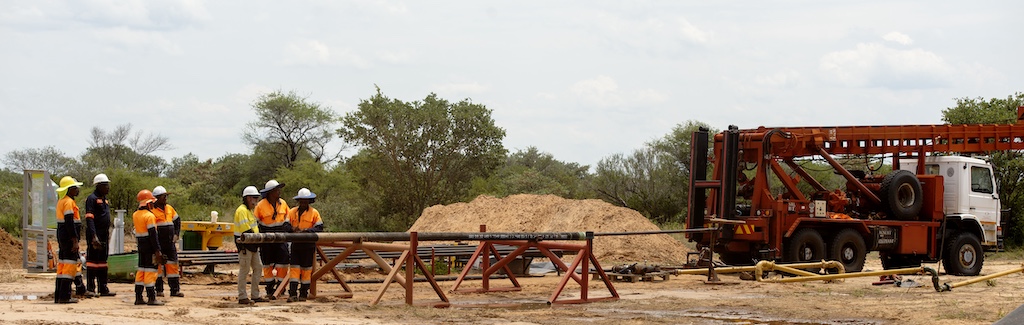
Botala Energy workers with drilling rigs. Environmental approval for gas exploration for commercial purposes has been approved. Photo: Tshekiso Tebalo / Oxpeckers
Inside the EIA report
The consolidated EIA report, including four voluminous reports totalling about 1,500 pages, deals with a number of red flags. These include the possibility of gas leaks, risk of damage to subsurface and cultural artefacts, loss of vegetation along pipeline corridor, proliferation of invasive plant species, loss and disturbance of fauna, loss of top soil caused by soil erosion, risk of cumulative climate change, increase in noise levels, oil and chemical spillages as well as reduced water levels and the contamination of ground water sources critical for the area’s ecosystem.
The report comprises primarily an environmental impact assessment and an environmental management plan (EMP).
The EMP, which is about 300 pages, was compiled on April 1 2025 and is complemented by three copies of the EIA, the last of which was modified for approval to address concerns raised by authorities about whether local farmers and borehole owners had been properly consulted.
These concerns were disputed in the report by Loci Environmental (Pty) Ltd, the environmental consultants commissioned by Botala Energy to do the EIA: “There are no local farmers associations in the area where the new project components will be located. The community, which includes farmers from both Mogorosi and Thabala villages, were consulted as well as neighbouring ploughing fields owners.”
“The Water Utilities Corporation, who owns boreholes near the project site, have been engaged and no response has been received thus far.”
Environmental approval for gas exploration for commercial purposes was approved in January 2026. But approval has not yet been given to an EIA submission made on January 26 2026, addressed to the District Co-ordinator in Serowe, relating to a request for gas beneficiation for downstream activities.
The EIA report records that public consultations were held in 2022 with communities in Thabala, Mogorosi, Paje, Serowe and Mmashoro, as well as local leaders, affected property owners, chiefs in Serowe and government institutions.
The public consultations were advertised in the state-owned Daily News on August 1 2022, but not in independent media outlets or social media platforms that are accessible to Batswana in urban areas like Gaborone and Francistown who own masimo (fields) in the areas being consulted for the EIA.
Consultations were held at traditional forums like the kgotla in affected villages – large tribal assemblies in villages used by traditional leaders to discuss important issues, policies and legislation.
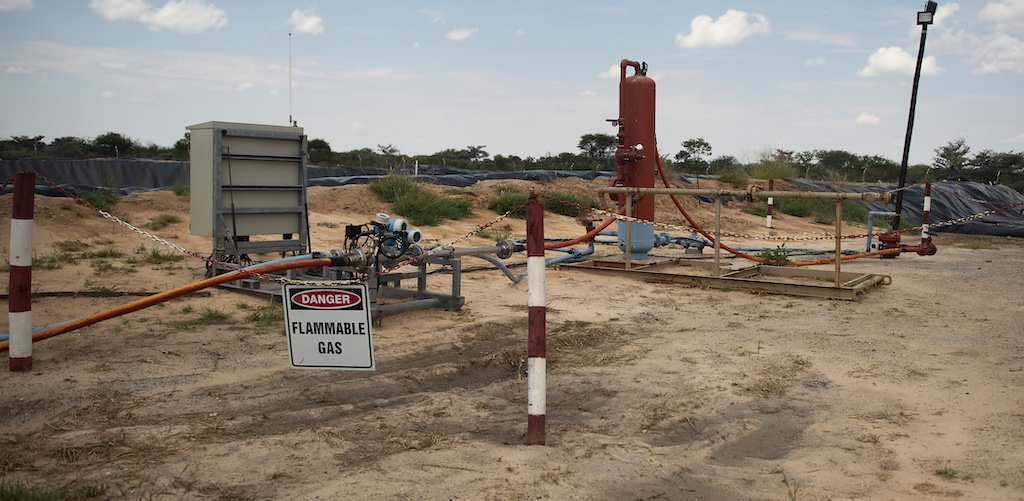
Possible gas leaks: The EIA report recommends air pollution from gaseous emissions should be monitored daily by Botala to ensure compliance with acceptable levels. Photo: Tshekiso Tebalo / Oxpeckers
Mitigation measures
In reponse to concerns raised about water contamination and water drawdown across the licence area of 511.39km, the EIA report advises monthly monitoring of water sources by Botala and that any contamination be identified and treated immediately. It also stresses that any reductions in water levels during weekly monitoring should cause Botala to identify alternative water sources for gas exploration activities
It recommends air pollution from gaseous emissions – carbon monoxide, sulphur dioxide and nitrogen dioxide – should be monitored daily by Botala to ensure compliance with acceptable levels.
Other mitigation measures include reporting subsurface artefacts and archeological sites to the Department of National Museum Monuments, developing dust suppression measures, routinely servicing vehicles and regulating speed limits. Botala is also encouraged to place soil contaminants such as fuel and chemicals on concrete bases with impermeable PVC lining to avoid spillage on the soil.
The EIA report observes that there are 45 large or medium mammal species within the project area, and recommends mitigation against vegetation clearance and other activities that may affect small species like reptiles, rodents and amphibious animals.
Boniface Olubayo, business advisor for Somarelang Tikologo / Environment Watch Botswana and a member of Botswana’s National Climate Change Committee, and his colleagues at the NGO have not seen the EIA.
Informed that Oxpeckers had viewed the document, he commented that Botala Energy should endeavour to surpass regulatory minimum standards, rather than just meeting the minimum standards set out for commercial expediency.
“For example, while the gas pipeline meets regulatory minimum standards, it could have been encouraged to do more. The pipeline is required to be 915mm underground and they have committed to being 1m underground,” he said.
This may prove to be problematic in an environment with vast temperature fluctuations that often affect the soil texture owing to evaporation which could affect pipeline. There was also the possibility of vandalism on a pipeline this long especially because it is close to the surface, he added.
Our ongoing investigation into Botswana’s gas project is part of the Oxpeckers #PowerTracker series titled ‘The human cost of energy in Africa’