
07 Oct An oily problem: Namibia’s hazardous drill-waste crunch
Two of Namibia’s only three hazardous waste sites are overwhelmed. John Grobler investigates what this means for the expansion of offshore oil exploration in the Orange Basin
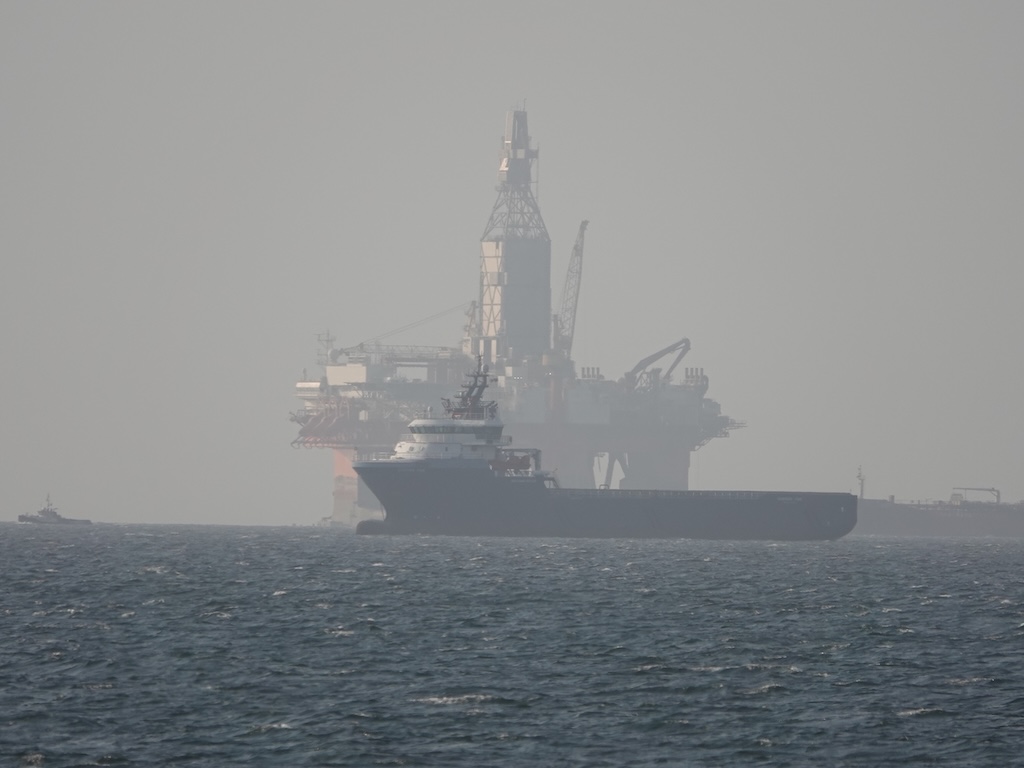
Getting crowded: Part of the growing fleet of drilling rigs and specialised oil service vessels moored offshore of Walvis Bay’s port, which is set to become the hub of an imminent oil and gas industry. Photo: John Grobler
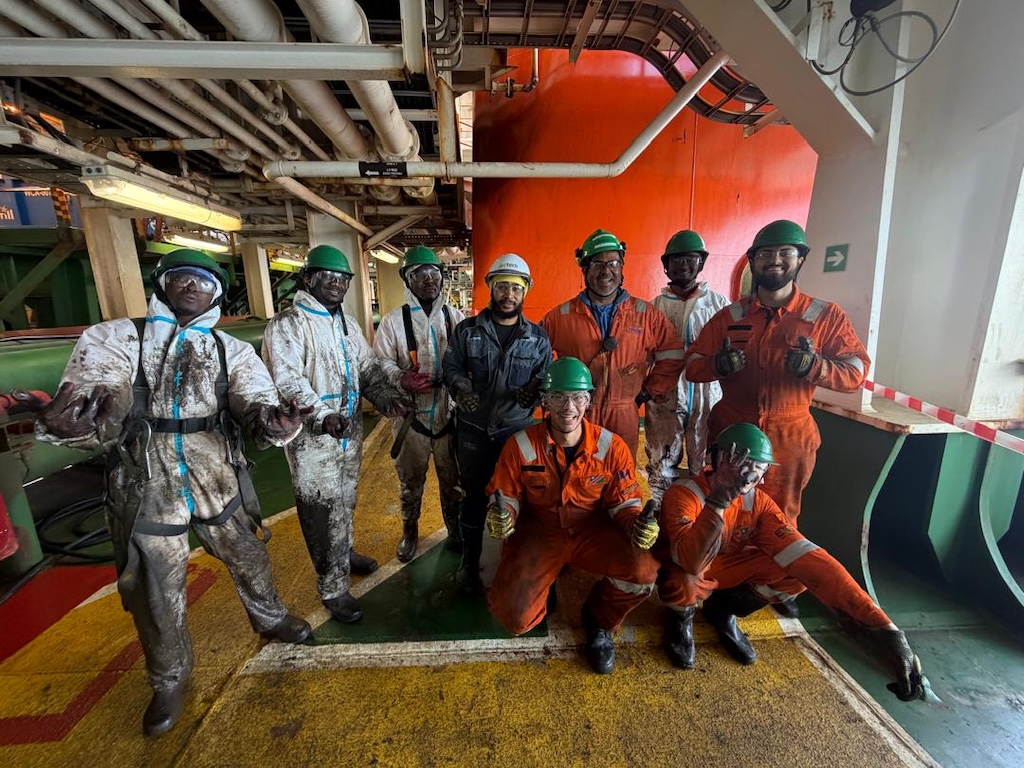
A dirty but profitable business: Eden Thermal Services operations manager Colin Brown (centre front) poses with his crew after successfully moving 1,200 tons of drill waste off a drill ship recently for local onland disposal. Photo: Supplied
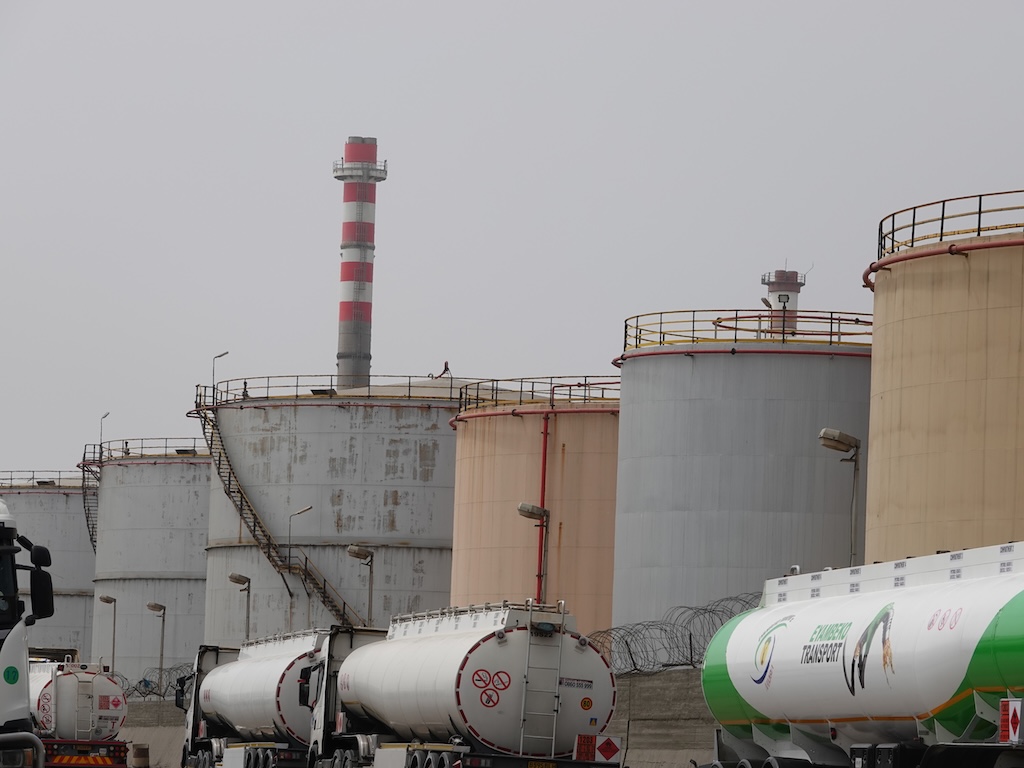
Strained capacity: Walvis Bay’s tank farm facilities, owned and operated by TotalEnergies, Puma Energy and national oil company NAMCOR, serve as a depot for supplying fuel to Botswana, Zambia and the DRC. Routine maintenance of these tanks are adding to Namibia’s hazardous-waste disposal woes. Photo: John Grobler
In his small Energy Street office behind the Walvis Bay fuel tank farm, Eden Thermal Solutions boss Colin Brown was talking urgently on the phone: the drill ship Carina West with 1,200m³ of drill waste material had just arrived in port and had to be off-loaded, processed and disposed of before it could sail for scheduled maintenance in Singapore in 10 days’ time.
Could he handle it? “Hell yeah – that’s what we’re here for, we’re all growing into this business,” he responded to an Oxpeckers reporter inadvertently overhearing the conversation.
He could not say anything more about where it came from or who the client was: all local companies doing sub-contracting work for the likes of Shell, TotalEnergies, Galp and BP searching for oil and gas in the Orange Basin have had to sign non-disclosure agreements.
But as one of the smaller Namibian industrial waste disposal companies hoping to benefit from Namibia’s imminent oil and gas industry boom, local removal and disposal, this was a major opportunity in the new oilfield service industry, he said.
However, in the absence of comprehensive drill waste disposal regulations and inadequate on-land hazardous waste facilities, it is an arrangement that in practice passes on most of the local risks to local sub-contractors, Brown later conceded.
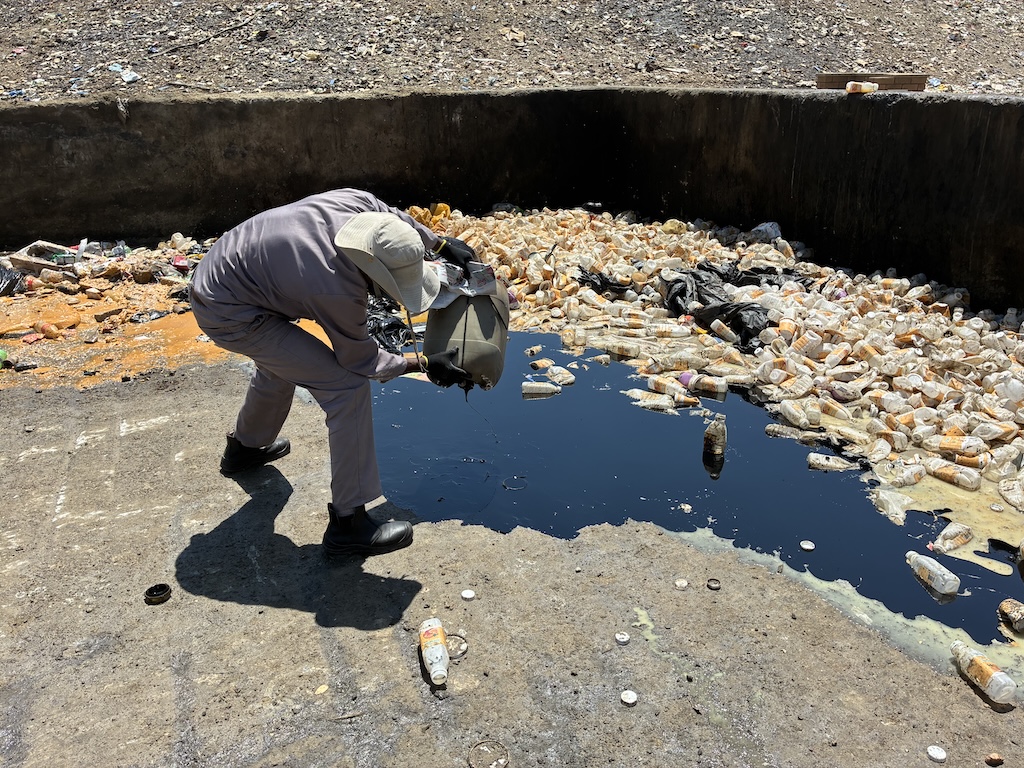
A messy business: A worker empties out old motor oil in the Windhoek municipal dumpsite Kupferberg’s small oil disposal facility, where all oily waste including old cooking oil is being disposed of. Like the others, this site is beginning to exceed storage capacity. Photo: John Grobler
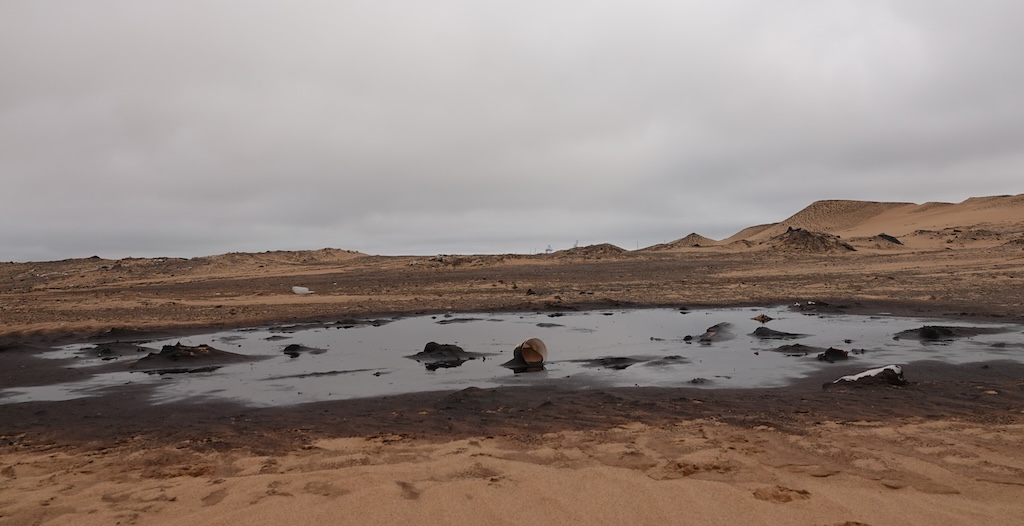
Environmental crime: Walvis Bay’s hazardous-waste facility was closed to more liquid oil waste after a rogue operator dumped large amounts of waste oil outside the facility in the dunes of the surrounding Dorob National Park and adjacent wetlands. Photo: John Grobler
Drill waste
The 1,200m³ of waste material Brown was dealing with was just the first wave of an incoming tide of drill waste that is being under-estimated, under-regulated and under-reported by the international oil exploration companies searching for oil in the Orange Basin.
For example, TotalEnergies’ final Economic & Social Impact Assessment (ESIA) report noted it had used conservative estimates in its projections of the total amount of hazardous waste of 12,195m³, or an average of about 305 cubic metres to be generated for each of the 40 wells it intended to drill.
A review of industry literature suggests that 300-500 tons of waste is typically generated during the first 1,000m of so-called riserless (without a casing connected to the drill rig) top-hole drilling that is typically discarded on the seabed.
At intermediate and reservoir sections, the use of specialised aqueous drill muds that expand to several times its volume when injected under high pressure, the drill waste output increases to 600-750m³ per well. In ultra-deep wells in the Orange Basin that on average are 6,000m deep, total waste generated including cuttings and fluids are estimated to run to between 1,100m³ and 1,500m³ per well.
Although Brown firmly declined to discuss any details of the drill ship in the harbour – such information was considered proprietary, he explained – it was confirmed by vesselfinder.com to be the West Carina drill ship. Shell’s regulatory filings showed it had completed the initial spudding phase drilling of Shell’s Merlin-1X well in July, which tallied with the 1,200m³ of drill waste sitting in the harbour.
TotalEnergies’ estimate of a total of 12,195m³ for 40 wells at an average depth of 6,000m was very low. At an average of 1,300m³ per well for 40 wells, the total amount of drill waste generated could be as high as 52,000m³, the calculation showed.
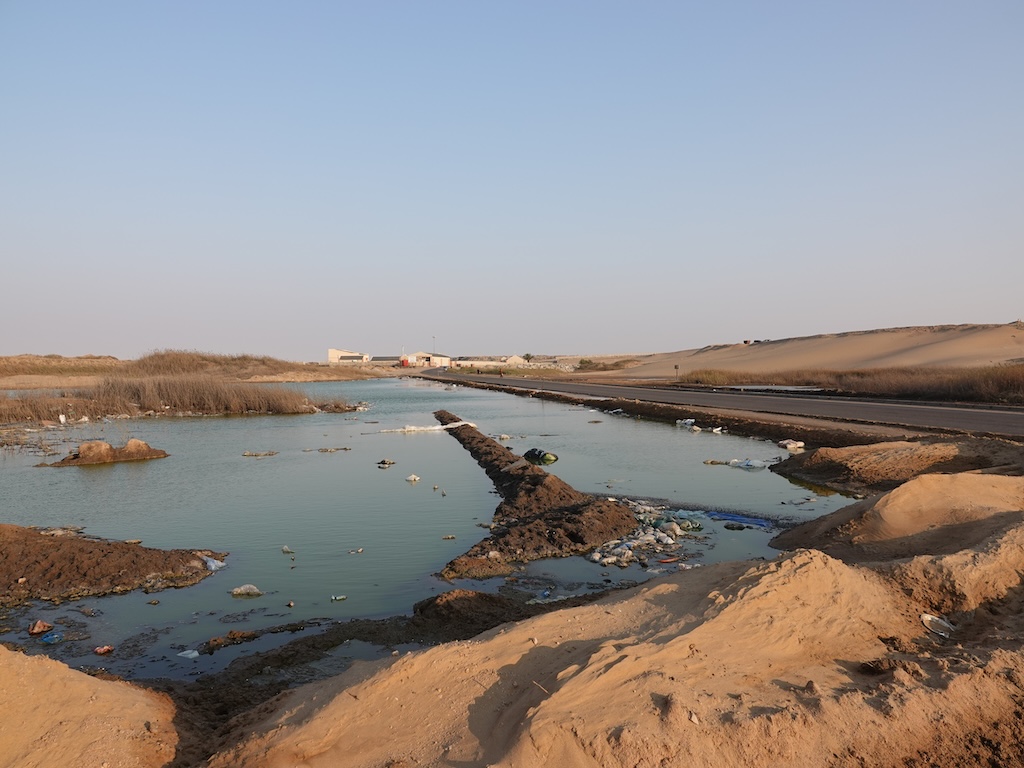
Overflowing: Walvis Bay’s municipal dumpsite and only coastal hazardous-waste disposal facility that, after years of poor management, has become an environmental headache for authorities. Uncontrolled waste disposal led to it being closed to more liquid oil waste generated by the offshore oil exploration industry. Photo: John Grobler
Drilling fluids
Most of this comprises water-based muds – drilling fluids used to lubricate the drilling process and stabilise ultra-deep wells, consisting mostly of corn starch and non-hazardous chemicals that can be safely disposed of at sea after treatment – according to TotalEnergies’s final ESIA report and other technical literature.
A smaller proportion of this is oil-based muds or synthetic-based muds that, according to the core principles of International Association of Oil and Gas Producer standards, has to be processed on board first and re-used or safely disposed of on land in certified hazardous waste sites.
Here, Namibia has a problem: at present, there are only three approved hazardous waste sites: two public landfill sites at Walvis Bay and Windhoek respectively, and a new private site at Arandis near the coastal town of Swakopmund, said Ministry of Environment, Forestry and Tourism (MEFT) spokesperson Vilho Hangula.
The Windhoek and Walvis Bay hazardous waste sites are both reaching full capacity, and the latter site closed down for disposal of oil-contaminated waste after a rogue operator dumped a large amount of waste oil in the dunes behind the landfill inside the surrounding Dorob National Park, Walvis Bay spokesperson Anita Kaihiva said.
A second private site, to be located about 21km outside of Lüderitz, is being planned. But the area first has to be de-proclaimed as part of the Tsau//Khaeb National Park and incorporated into the official townlands of Namibia’s second, southern-most port, according to the MEFT and industry sources.
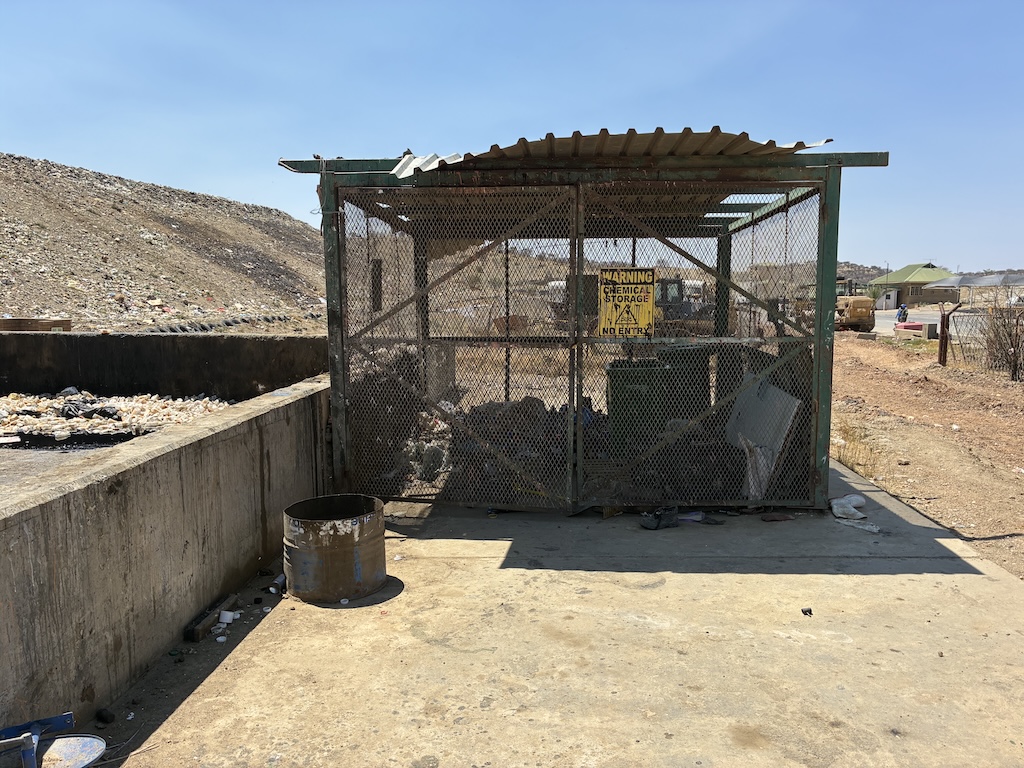
The small chemical waste disposal facility at Windhoek’s Kupferberg landfill, where all dangerous chemical waste has to be disposed of. With Namibia poised to become industrialised over the next four years, this small facility is too small to deal with future demand for specialised waste disposal. Photo: John Grobler
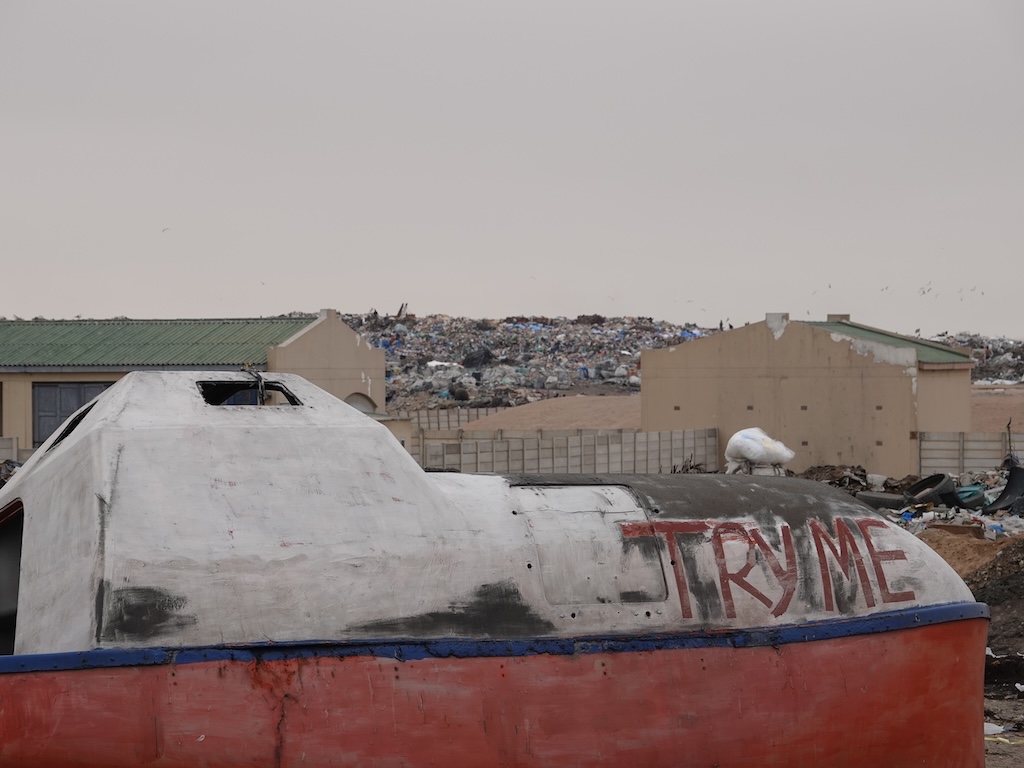
As Namibia moves towards oil production, outdated laws and weak enforcement could leave gaps in the regulation of offshore drilling waste. The Walvis Bay landfill, for example, was closed to liquid oil waste from offshore exploration in 2024 after its tanks reached capacity and rogue operators dumped waste oil in the surrounding dunes. Photo: John Grobler
Legal shortcomings
A review of technical literature shows that in the northern hemisphere regulations, the OSPAR (Oslo-Paris) Commission under the Convention for the Protection of the Marine Environment of the North-East Atlantic is enforcing a zero-discharge rule of not allowing any disposal of any drill waste at sea. However, in the southern hemisphere, similar regulations are either very watered-down or largely absent.
Stefanie Busch, a lawyer specialising in mining and environmental law, said a further legal shortcoming is that Namibia’s outdated Petroleum (Exploration and Production) Act of 1991, which regulates drill waste disposal, only applies to petroleum exploration licence (PEL) holders, not to petroleum production licence holders.
The legislation provides for just a R20,000 fine for transgressions, Busch said at the recent launch of the fifth, revised publication of the Environmental Law and Policy in Namibia handbook.
“We have not started [oil] production yet, so we still can address shortcomings to reduce Namibia’s carbon footprint,” she said.
Environmental Commissioner Timoteus Mufeti, part of the panel of experts attending the launch, agreed that this was now a matter of urgency as he was about to issue TotalEnergies with an Environmental Clearance Certificate for the Venus oilfield, located about 300km south-west of Lüderitz and adjacent to the South Africa-Namibia maritime border in the ultradeep waters of the Orange Basin.
The absence of enforceable law could be addressed by attaching specific conditions to the Petroleum Production Agreements between oil producers and the government, but the enforcement of environmental regulations on drilling operations 200km to 300km out at sea was going to be a challenge, Mufeti said.
However, the shortage of certified hazardous waste sites was something that could be easily addressed, he said – hinting perhaps that, in view of the poor state of the Walvis Bay and Windhoek landfill sites, this sector is to be privatised.
Legal experts warn that under the Petroleum (Exploration and Production) Act of 1991, only holders of petroleum exploration licences are held liable for any oil spills – but not the future operators of petroleum production licences. This shortcoming is also not being addressed in a pending amendment to the Petroleum Act. Photo: John Grobler
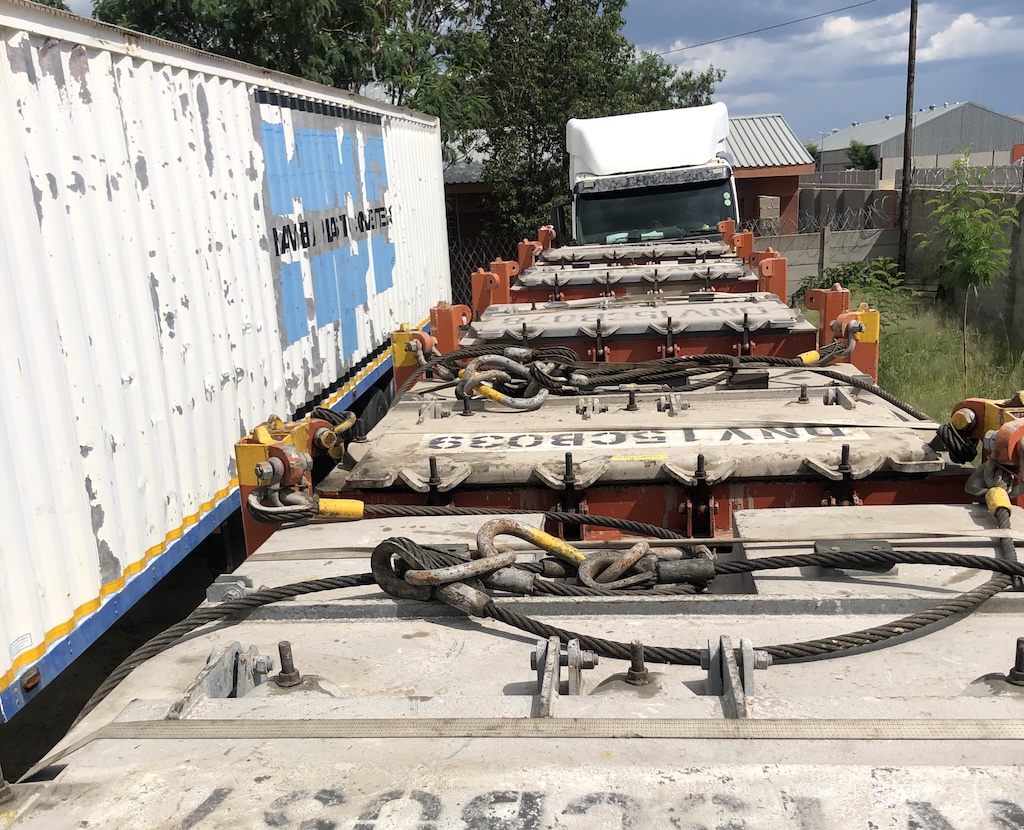
Specialised oil industry equipment: Drill waste must first be processed on board of the drill rig and then stored in these special leak-proof containers for disposal on land, a costly exercise as these oil waste skips are rented out at US$85 per day. Photo: John Grobler
Radioactive waste
Dr Detlof von Oertzen, a nuclear energy expert who was also part of the panel as author of two chapters in the handbook on the oil and electricity sectors and who co-authored a third chapter on clean energy policy, warned that Namibia at present also did not have a specialised hazardous storage facility for low-level radioactive waste
“The suggestion that a solution will be found seems overoptimistic to me, considering MEFT’s poor track record in ensuring that waste sites are managed professionally,” he said.
While the relatively small Arandis site, owned and operated by Séché Environnement’s local subsidiary Namwaste, could be expanded as needed, “… there is no waste site for radioactive materials, which is essential for the oil and gas industry”, Von Oertzen said.
This is of concern for two reasons, he said: firstly, specialised oilfield service experts like Haliburton, Baker Hughes and Schlumberger make use of radioactive isotopes in calibrating drill logging equipment. While Schlumberger and Baker Hughes are accredited by the National Radioactivity Protection Agency and both have applied for environmental clearance to operate such sites, none has been granted yet.
Secondly, oil and gas exploration has since the 1980s known to be a major source of naturally occurring radioactive materials (NORMs) such as uranium, thorium, potassium, radium and radon gas.
None of the international oil companies active in Namibia’s ultra-deep offshore have thus far reported any major risk of NORMS. However, the real risk is further down the line: according to the United States Geological Service, high levels of radioactivity was first detected in the recycling of used oil pipelines where a build-up of barite scale was a major source of radon gas.
“I’m most concerned that the absence of suitable waste disposal facilities may delay efforts to ramp up the oil and gas industry, and may result in uncontrolled disposal which will be most expensive to manage in future,” said Von Oertzen.
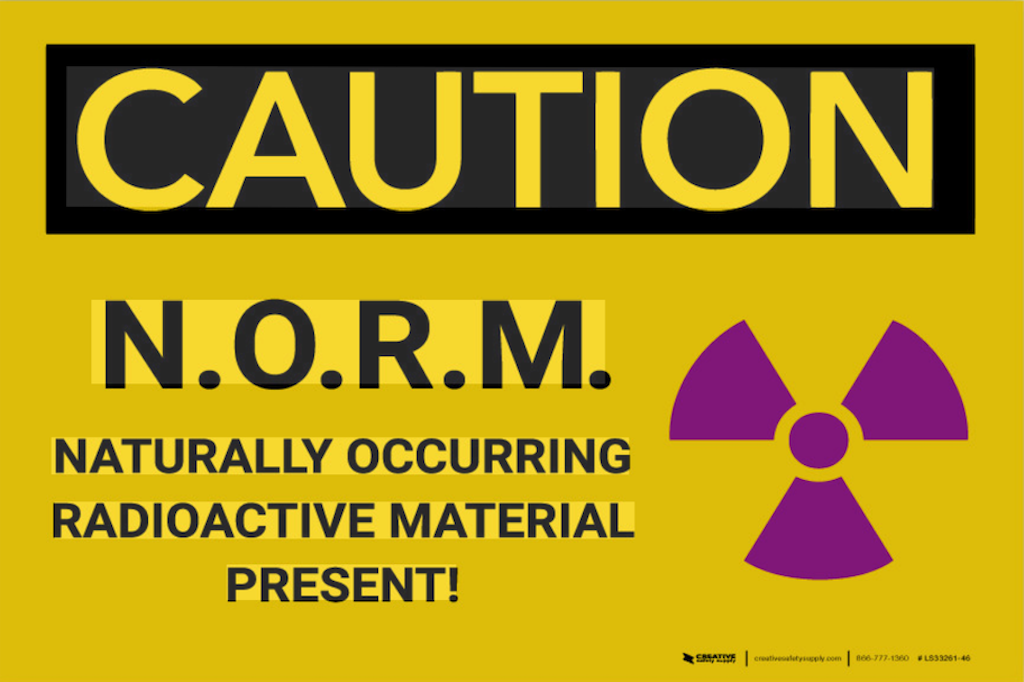
Namibia currently has no facility to store low-level radioactive waste such as Naturally Occurring Radioactive Materials commonly associated with oil and gas exploration, coal power plants, mining and metal refining, fertiliser production and water treatment plants. Photo: John Grobler
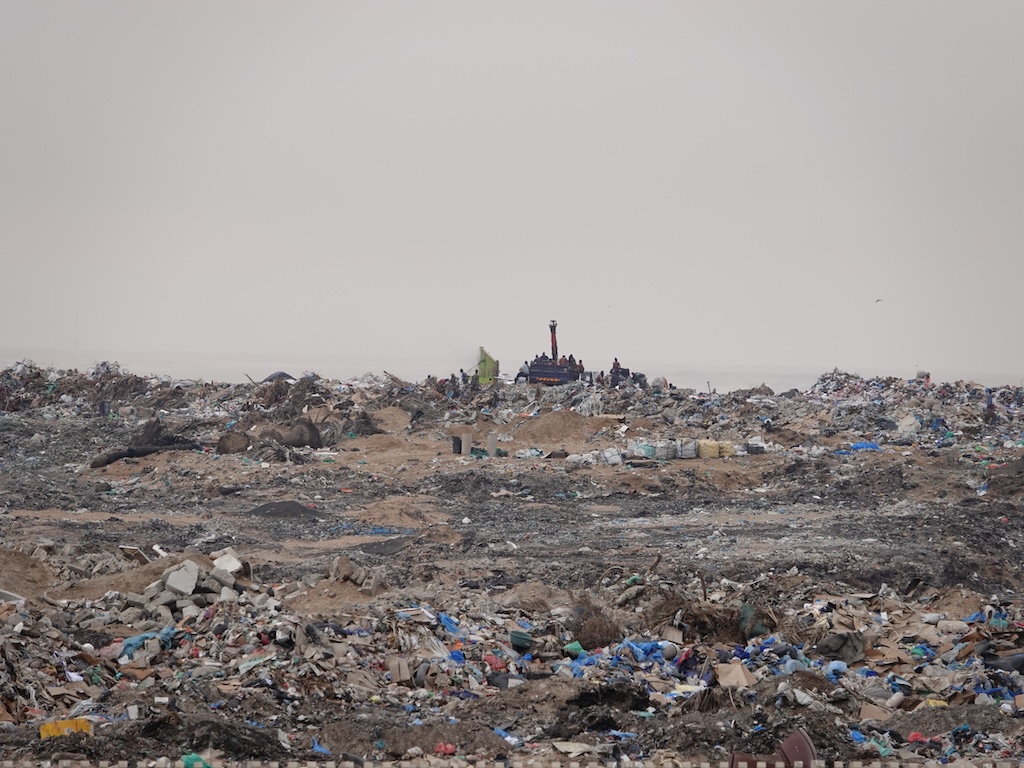
The Walvis Bay landfill site is permanently occupied by waste-pickers who may inadvertently have been exposed to Normally Occurring Radioactive Materials (NORMS) over the past five years due to a lack of proper waste management control by the Ministry of Environment, Forestry and Tourism (MEFT). Photo: John Grobler
NORM regulations
Axel Tibinyane of the National Radioactivity Protection Agency said under the Atomic Energy and Radioactivity Protection Act of 2005, the agency is not responsible for establishing any radioactive waste site, but only for the monitoring of NORMS.
“We are not aware of any NORM that is stored at landfill sites, nor have we granted approval for such arrangements,” he said. The agency was in the process of drafting specific NORM regulations, he confirmed in an email.
Namibia’s infrastructural and regulatory deficiencies are major reasons not to get rushed into oil production, Columbia University’s Professor Jenik Radon warned a week later at a Bank of Namibia symposium to assess the country’s readiness for an oil industry.
“International oil companies can take advantage, especially if your legal system is not prepared,” he said in remarks quoted by The Namibian.
He also urged Namibia not to succumb to pressure from TotalEnergies to agree to a financial stabilisation clause – the main sticking point in current negotiations – that would prevent the country from enforcing any new laws in the future to address regulatory shortcomings.
The 2025 Amendment to the Petroleum Act has been stuck in Parliament since February over objections to its fundamental flaws, namely too much centralisation of power in the Office of the President and too little transparency and accountability. (See Unchartered waters: Inside the political battle for control of the Orange Basin oil and gas resource.)
As the central regulatory law to govern a future Namibian oil and gas industry, the still-stalled Petroleum Act Amendment Bill presented the best opportunity to address all structural and legislative shortcomings. The question is, will this happen before TotalEnergies is issued with an environmental clearance certificate for the Venus oilfield?
• Find the data used in this investigation in the Oxpeckers Get the Data section here
John Grobler is a Namibia-based associate at Oxpeckers Investigative Environmental Journalism. This is an overview and analysis of a series of #PowerTracker transnational investigations that interrogate the environmental, socio-economic and political impacts that the Orange Basin Corridor oil and gas developments could potentially bring.
.