
23 Feb The green panopticon: When saving rhinos means watching people
Tulani Ngwenya investigates how US dollars and hi-tech security have turned South Africa’s game parks into a fortress frontier
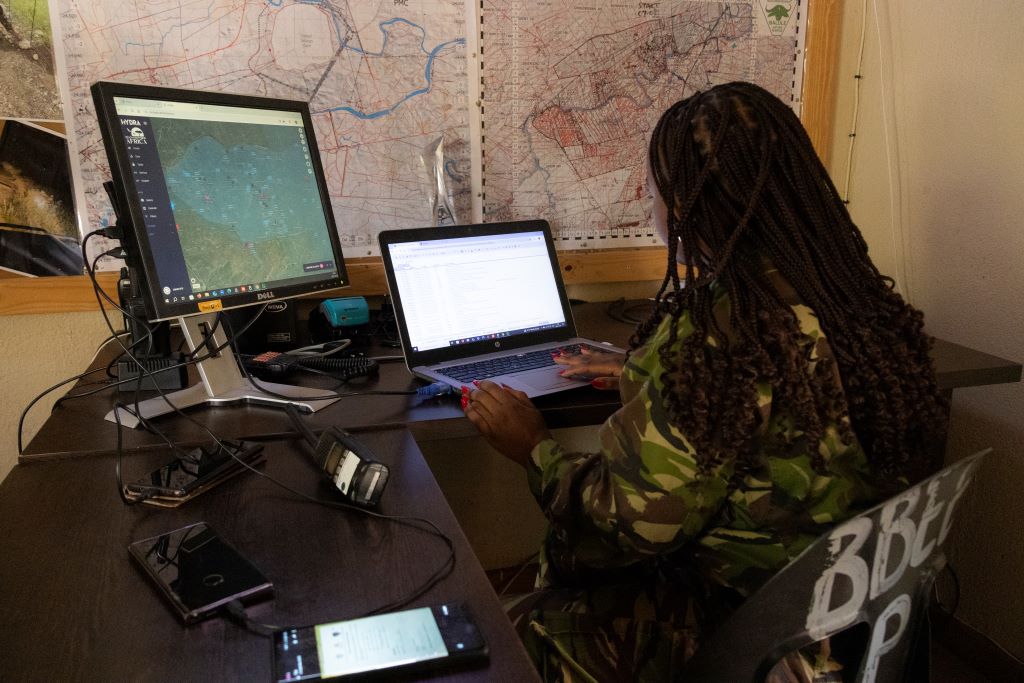
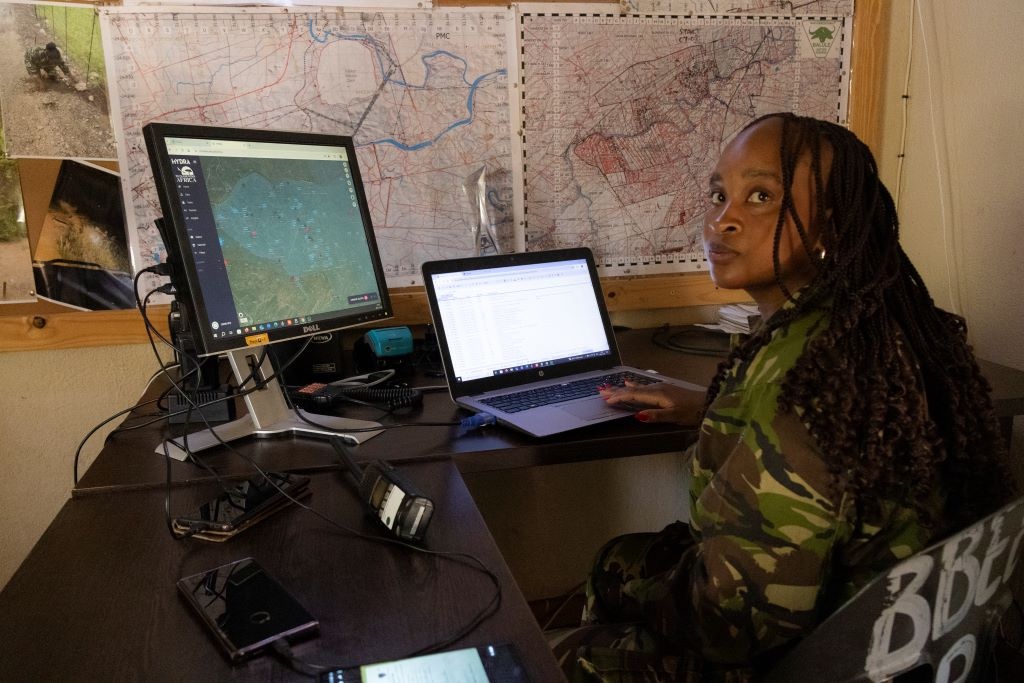
On the operations room monitors, a Black Mamba ranger works with a software platform that tracks and manages activity across the reserves in real time. Photo: Rifumo Mathebula
In a control room of the Black Mambas, a private anti-poaching unit that patrols 20,000ha within South Africa’s Greater Kruger National Park region, saving wildlife resembles a digital battlefield: live digital feeds and maps automatically tag every vehicle crossing the park’s perimeter, logging licence plates, times and GPS coordinates into a central database.
The setup is similar to a panopticon, a circular prison with cells arranged around a central well from which prisoners could at all times be observed, and provides an example of how global security priorities are integrating hi-tech into the African conservation landscape.
Data shows that between 2020 and 2025, United States government agencies channelled US$2.9-billion into South Africa’s conservation sector. Funded activities included rhino protection, anti‑poaching operations, ranger support, and strengthening law enforcement and judicial services. Some of the grantees listed are the Pilanesberg and Madikwe Nature Reserves, the Peace Parks Foundation, the Endangered Wildlife Trust and the South African government.
These funds underwrite a parallel track of militarisation, drones, ranger training, border intelligence systems and command centres, according to foreignassistance.gov, the US government’s public dashboard for tracking foreign aid.
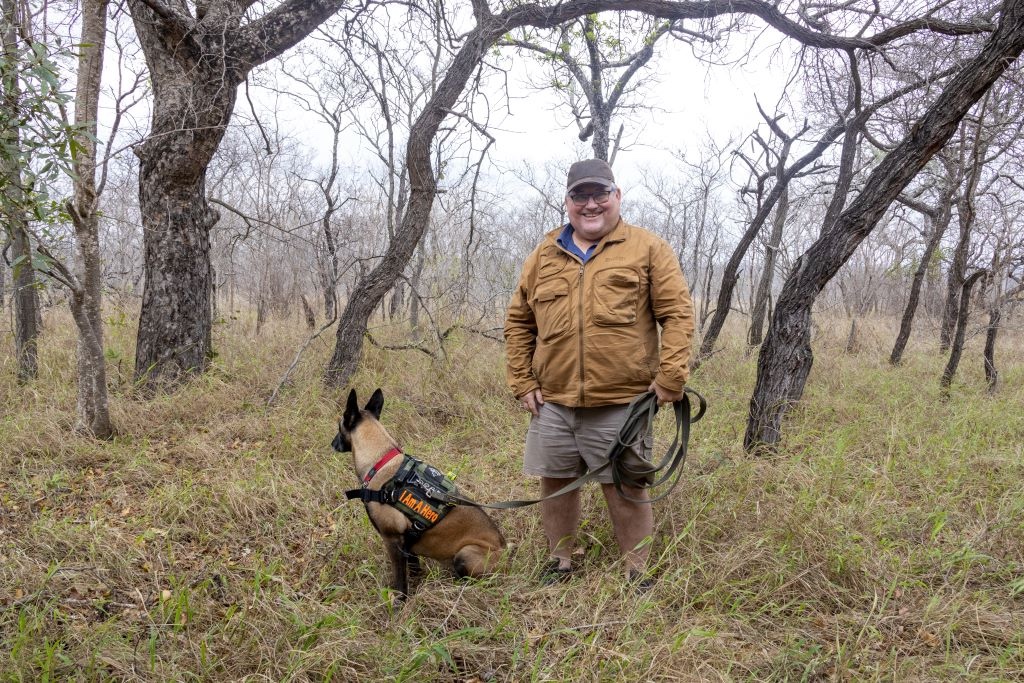
Ashwell Glasson: ‘Donors have pushed near-military-grade technology since the 2008 rhino poaching spike.’ Photo: Rifumo Mathebula
Modern tactics
Ashwell Glasson, who conducts research into the irregular warfare–crime–conservation nexus, stresses that the militarisation of conservation is rooted not only in modern tactics and technology but in colonial and apartheid legacies, when ranger corps were structured as paramilitary forces tasked with protecting parks through policing rather than ecological stewardship.
“Donors have pushed near-military-grade technology since the 2008 rhino poaching spike,” he said.
At an entry gate at the Kruger National Park, Glasson pointed out: “Your car’s number plate would have been entered into a database. If it was flagged previously in a criminal event, it would appear in the system.”
Automated licence plate recognition (ALPR) uses closed-circuit television (CCTV) cameras and optical character recognition to read cars’ number plates and log them with time and location data. In conservation areas, the system functions as a policing tool, flagging suspect vehicles and linking park surveillance directly into broader crime‑intelligence networks.
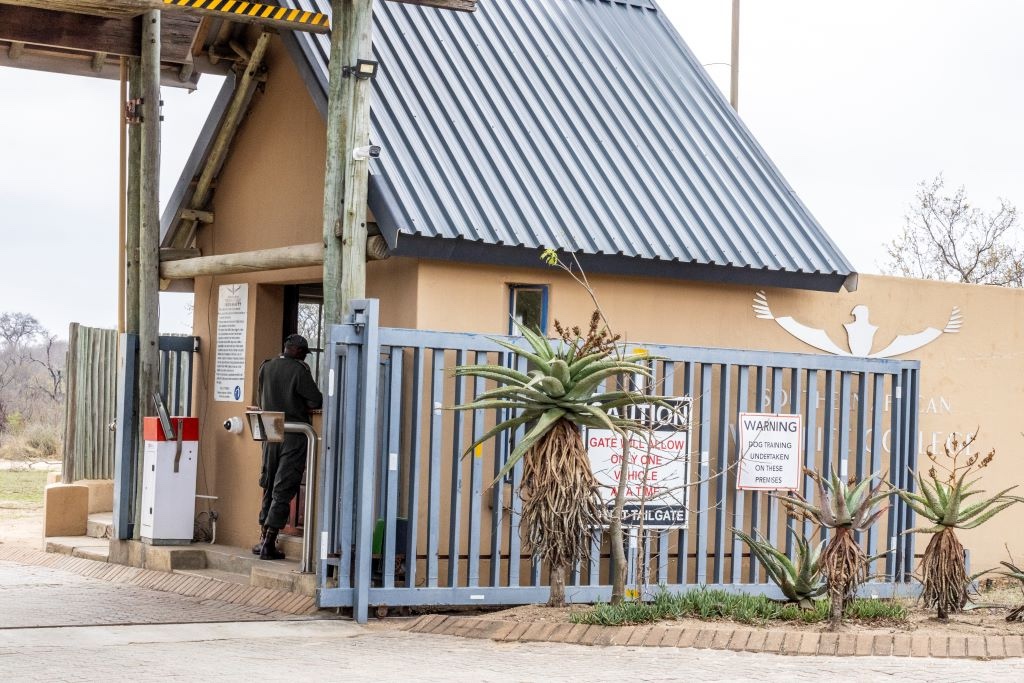
An automated licence‑plate recognition CCTV node at the entry to the Southern Africa Wildlife College in the Greater Kruger National Park area. Photo: Rifumo Mathebula
Response to a necessity
Johan Jooste, the former commander of special projects at South African National Parks and the architect of Kruger’s modern anti-poaching strategy, described militarisation as “a professional response to necessity”.
A retired major general with 35 years in the South African National Defence Force, he oversaw security in all 22 national parks from 2012–2020.
“I overtly and responsibly adopted applicable military tactics and techniques to ensure a capable ‘paramilitary’ ranger corps that could stand up to armed poachers daily,” Jooste told Oxpeckers.
“The whole concept was based on surveillance, early warning, detection and tracking… to avoid unexpected contact and exchange of fire.” Intelligence, he adds, was integrated daily across agencies and captured on a digital platform called CMORE platform.
CMORE, developed by the Council for Scientific and Industrial Research, coordinates anti‑poaching operations by integrating data from sensors, patrols and agencies into a single shared system, enabling rangers, police, and military units to share intelligence securely and respond faster to threats.
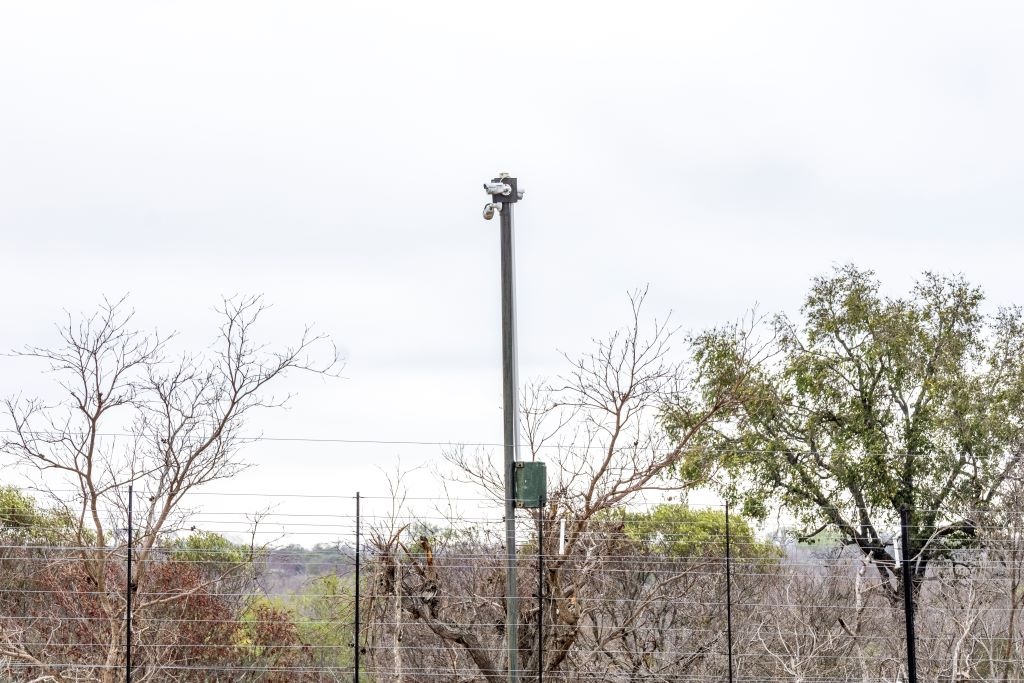
Triple‑view perimeter surveillance: A dual‑sensor PTZ unit scans the protected area and both sides of the highway, anchoring Kruger’s electronic fence. Photo: Rifumo Mathebula
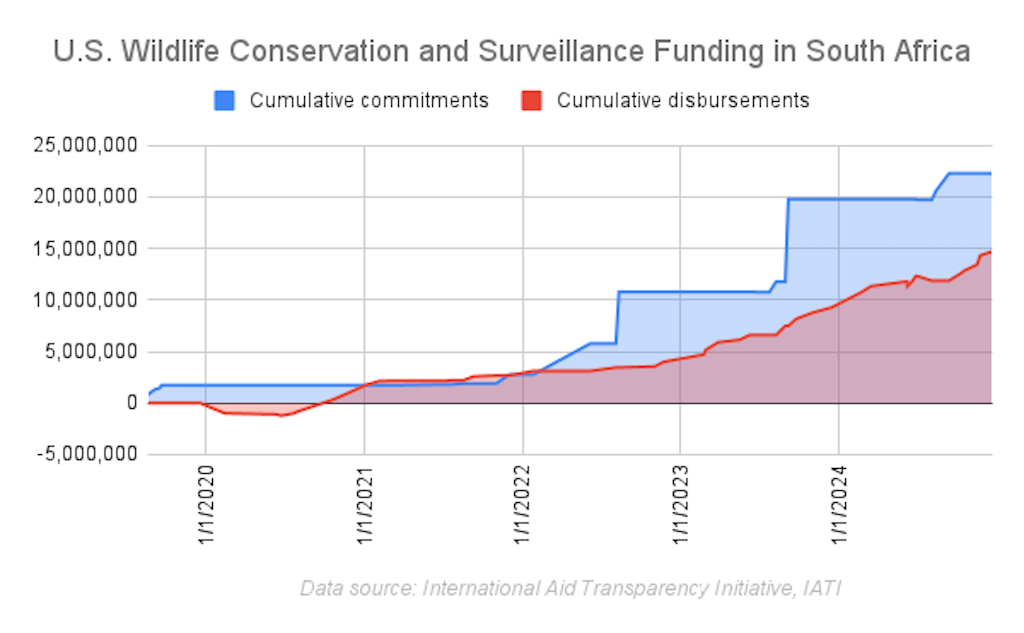
Billions committed, millions disbursed: Surveillance dollars that reshaped South Africa’s parks between 2020 and 2024. Graphic: Purity Mukami
Donor agendas
Tafadzwa Mushonga, a University of Pretoria research fellow whose work interrogates the politics of conservation financing and security governance in Southern Africa, said her studies between 2022 and 2025 had highlighted tensions between donor agendas and constitutional mandates.
“Money funding conservation operations on the ground is often tied to foreign interests and conditions… Global North conservation security agendas can never be reconciled with constitutional obligations,” she said.
“While donors like the US fund training and capacity‑building, on‑the‑ground tactical command is the responsibility of the country’s own agencies,” said international law enforcement and compliance consultant Davyth Stewart.
He noted that donor governments often attach end‑use monitoring clauses to equipment, but “their effectiveness depends entirely on national governance”.
Stewart cautioned that framing wildlife crime as “insurgent activity” risks pushing conservation into military frameworks with weaker safeguards for rights and oversight. Militarised border patrols, he warned, may be politically attractive yet divert attention from dismantling the financial flows that sustain environmental crime.
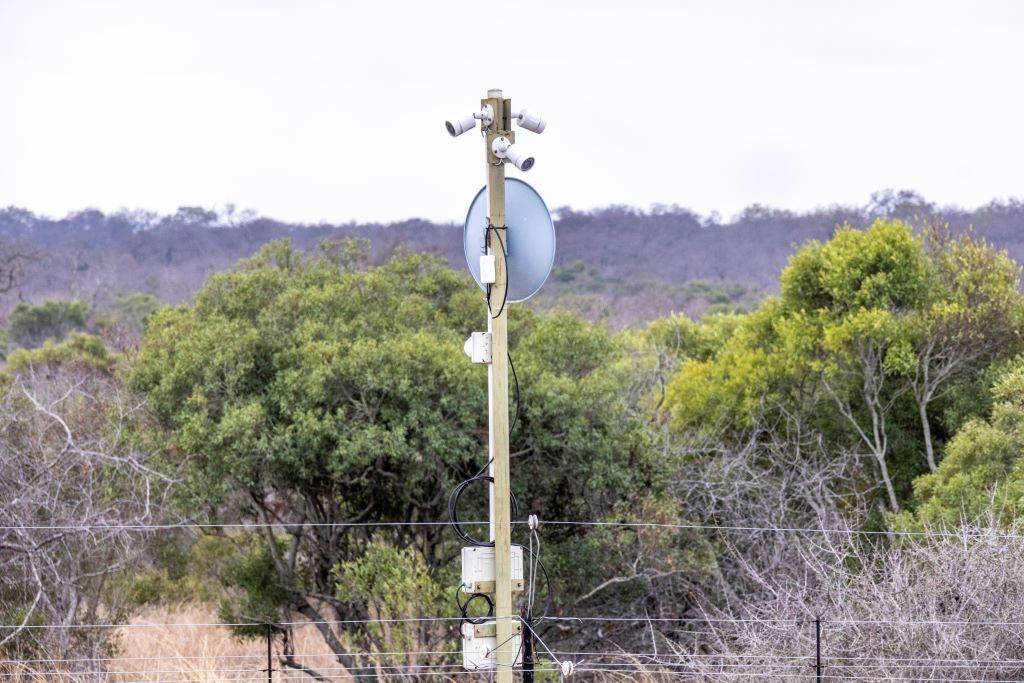
Pole‑mounted surveillance node with clustered fixed cameras, multidirectional eyes scanning both sides of the highway and straight ahead along Kruger’s electronic fence near Orpen Gate. Photo: Rifumo Mathebula
Formal policy
Oxpeckers sent questions to South African National Parks and the Department of Forestry, Fisheries (SANParks) and the Environment (DFFE) asking for details of their formal policy on using donor funds for surveillance technology such as licence plate recognition, drones, CCTV and militarised strategies in conservation.
SANParks spokesperson Rey Thakhuli replied: “The information you require is highly confidential and will not be shared with any third party, including members of the media.”
“State security protocols and applicable legislation guide SANParks in respect of surveillance technology. DFFE and SANParks do not have donor-funded projects for surveillance and /or militarised strategies in national parks,” responded the DFFE’s media desk.
“SANParks determines its own security requirements in line with its operations and follows National Treasury prescripts in procurement.”
Asked for a breakdown of funding involving community and technology‑led conservation, the DFFE highlighted the GEF‑6 Illegal Wildlife Trade Project, active since 2020, supporting governance reforms and environmental monitors along Kruger’s western boundary. It also pointed to the Integrated Wildlife Zones Project with Peace Parks Foundation to reduce poaching, and the GEF‑7 Pillar 1 Project, implemented by UNEP and executed by DFFE, aimed at strengthening wildlife crime enforcement, investigations, prosecutions and forensic capacity.
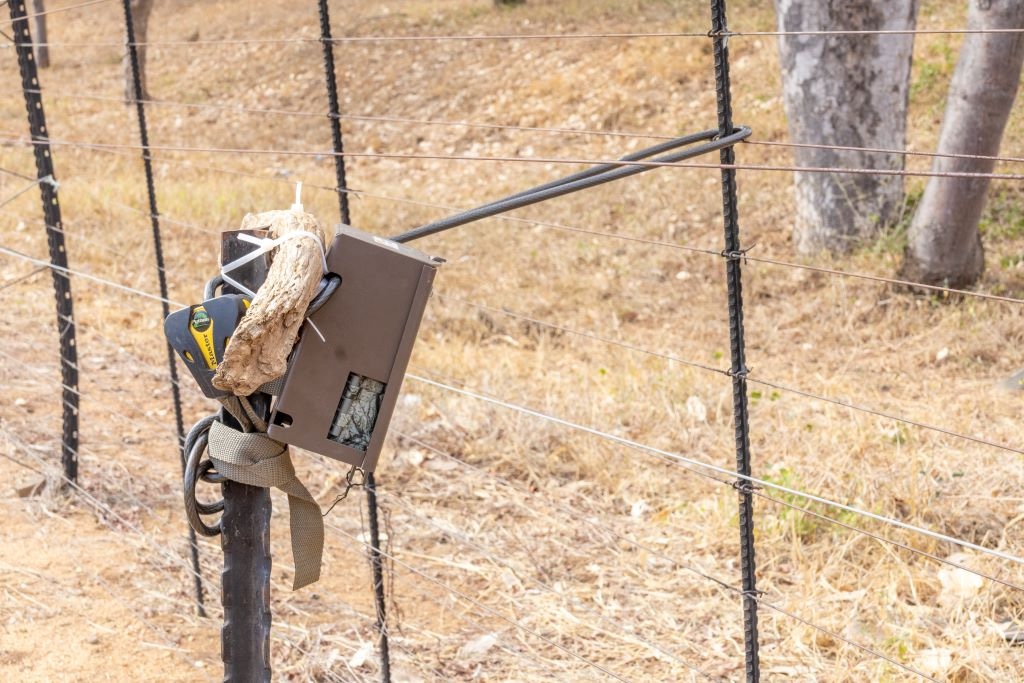
Close‑up trail cam fixed on the highway underpass, monitoring tunnel movement beyond Greater Kruger’s fence line. Photo: Rifumo Mathebula
Cross-border defence
The South African National Defence Force’s Joint Operations Division said its operations in Kruger form part of Operation Corona border patrols “to deter cross-border illegal activities inside the park authorised under Section 201(2) of the Constitution, which empowers the President to employ the Defence Force”.
It added that Kruger’s position along the Mozambique-Zimbabwe border makes it part of its “legal mandate to protect territorial integrity”.
Asked whether donor‑funded assets or training were used in anti‑poaching operations, the reply was blunt: “No.”
The South African Police Service (SAPS) was similarly asked to disclose its ALPR data‑sharing policies and integration agreements. That request went unanswered.
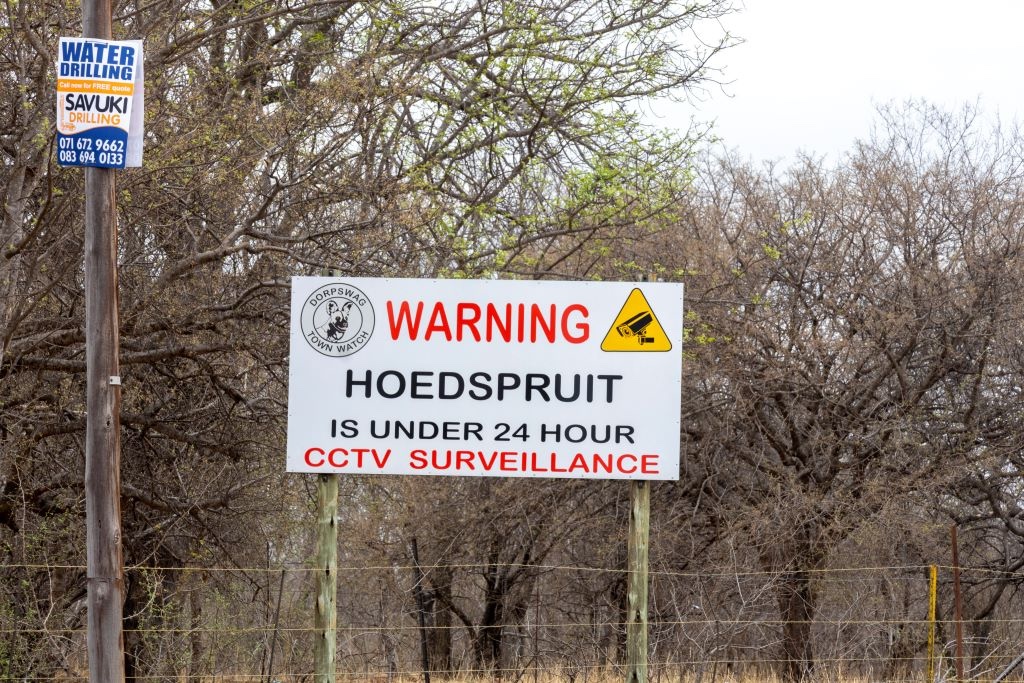
Hoedspruit, a gateway to the Kruger National Park and other tourism attractions in Limpopo province, is under 24-hour CCTV surveillance. Photo: Rifumo Mathebula
PAIA probes
This investigation used the Promotion of Access to Information Act (PAIA) to request records on surveillance technologies, data‑sharing agreements, and procurement from four agencies: the DFFE, SANParks, the North West Parks Board, and SAPS.
The filings asked a simple question: who controls the surveillance data, and who has access to it?
The DFFE acknowledged receipt, but no disclosure had followed at the time of publication. SANParks confirmed receipt via the chief executive’s office, yet no records have been released. The North West Parks Board circulated the request between October 21 2025 and January 28 2026, but produced no substantive reply.
Tech‑law expert Nerushka Bowan commented that South Africa’s data protection regime, the Protection of Personal Information Act (POPIA), “was drafted well before the advent of large language models and sophisticated AI models”. While it applies to personal information processed by AI, Section 37 allows exemptions for “security” or “research”, opening the door for conservation surveillance to bypass full compliance.
“There are other AI‑specific risks, outside the realm of data protection, that POPIA would not directly cover. These include risks of bias, misidentification, or false accusations,” Bowan noted.
“Section 71 requires explanations for automated outcomes,” she explained, noting that liability falls on the authority processing the data, not the vendor or funder. Thus communities flagged by predictive analytics are left with little recourse, even as surveillance expands under the banner of conservation.
This investigation by Oxpeckers Investigative Environmental Journalism is part of a collaboration in partnership with Sam Schramski, Benon Oluka and Purity Mukami, produced with the support of the Pulitzer Center